By Scott McIntosh
NOTE: This column first appeared in the Idaho Statesman on Nov. 9, 2023; it is reprinted here by permission.
You’d think that after 48 years and covering an estimated 1,000 City Council meetings, Mark Steele would take a break.
But last week, even after he ceased operation of his weekly newspaper, the Caribou County Sun, Steele found himself at Soda Springs City Hall.
“Believe it or not, I was driving past the City Council meeting the other night, the first meeting after we shut the newspaper down, and I pulled in there just to attend,” Steele told me in a phone interview. “You miss the knowledge of what’s going on and the habits that you’ve done all these years. You still want to be a part of the loop.”
Oct. 26 was the final issue of the Caribou County Sun, owned by Mark and Wendy Steele, who were a young couple in their 20s when they bought the paper in their hometown 48 years ago.
Steele, 74, told me revenues dropped 40% from 2019 to 2022, mostly from advertising, a combination of businesses closing during the Covid pandemic or cutting back on their advertising. Add in inflation, retiring staff and no buyers for the paper, and the time had come to close up shop.
So what does the community lose when it loses its newspaper?
“I think you become a town and not a community anymore,” Steele said. “I think that the print newspaper in a small town was this historical record. It was a place to go to find out the events of what was going on. And with that gone and not replaced, I think the community is not near as close, and then you become just another town.”
NATIONAL TREND
Unfortunately, the closing of the Caribou County Sun is not an outlier. On average, since 2004, two newspapers have closed per week. That’s 2,500 closures, according to research from the Medill School of Journalism at Northwestern University. From 2019 to 2022, 360 newspapers closed, almost all of them weeklies.
The result is what’s called “news deserts,” primarily in poorer and rural communities.
Meanwhile, the Kuna Melba News, which started in 1982, will no longer exist as a newspaper title, as it’s being wrapped into the Meridian Press, which is rebranding as the Meridian-Kuna Press. The loss of the Kuna Melba News hits close to home, as my wife and I owned that weekly newspaper from 2006-11, which were among the most gratifying years of my journalistic career.
The community loses something vital when it loses its newspaper.
“I think a good newspaper is a community talking to itself, whether it’s letters to the editor, or the guy next door to you doesn’t like your editorial and comes over and tells you so,” Steele said.
LOCAL WATCHDOG
An even bigger loss is the loss of a watchdog on local government that just isn’t being replaced.
“Sometimes you hold the feet of officials to the fire, which in my opinion is all good,” Steele said. “They know darn well the budget’s going to get discussed, the new truck they buy, you know all of that stuff sees a little bit of light of day. And if it’s a reasonably good newspaper and doing its job, that community will benefit from that.”
That type of accountability reporting leads to lower government costs. A 2018 study from the University of Illinois at Chicago and University of Notre Dame found that municipal borrowing costs increased by as much as a tenth of a percent after a newspaper shuttered, translating to millions of dollars in additional costs between 1996 and 2015.
Further, as was suggested by a PBS News story in August, the loss of a newspaper fuels an increase in political divisions, something Steele said he’s seen himself.
“What I’m seeing as a trend is some people are getting a little more demanding and entitled — they’re still rare, at least in rural communities that I’m familiar with — but this trend in this tribalism we talk about and see nationally is also more and more locally in some respects. And that bothers me a great deal for the future.”
Other research has shown that communities that lose their newspaper have lower voter turnout, a greater spread of misinformation and lower trust in democratic institutions, according to the Local News Initiative at Northwestern’s Medill School.
IS THERE A WAY FORWARD?
The Local News Initiative points to the rise in digital-only outlets providing local news, and there are success stories out there.
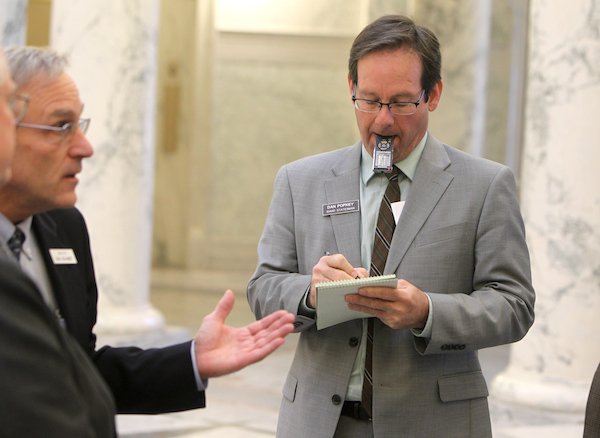
Steele and I reminisced about the culture and work ethic of putting out a weekly newspaper, having our kids in the next room while we worked on that week’s edition of the paper. The weekly newspaper editor does it all, covering high school sports and school board meetings, shooting our own photos, laying out the paper, picking up the copies from the printer (in Mark’s case, two-and-a-half hours away in Brigham City, Utah) and delivering it yourself.
“I don’t think very many people realize how much work goes into putting out a print newspaper,” Mark said. “I think they would be shocked how labor-intensive it tends to be.”
But the flip side of that is that without a printed paper, the barriers to entry are super low. Without the need to design and lay out a 20-page newspaper every week or pay to print it, mail it and deliver it, running an online news site is easier than ever. But that’s not for Steele.
“I’ve been a man of ink-on-paper all my life, and I don’t know what the hell you do now,” Steele said. “It’s very, very sad.”
Steele said he looked for a buyer of the Caribou County Sun, but there just aren’t any young couples like him and Wendy, and me and my wife, who are looking to take over a small weekly newspaper these days.
“My hope is that if I’m out of the way, maybe something will come in and fill that void, whether it’s an existing publication, something existing online, and I think there will be several avenues of that,” Steele said.
The question is whether a small community like Kuna or Soda Springs would have enough digital subscribers and a large enough advertising base to support a niche online-only local news outlet. But if you can do it, I can attest, and Steele would agree, it’s probably the most rewarding experience you can have.
“You don’t make a great living, but you make a living,” Steele said. “You pay your bills, you keep people working, you’re the heartbeat of the community, and you feel like when you go to bed at night, you’ve done some good.” For the past 48 years, the Steeles, indeed, have done some good.
Scott McIntosh is the opinion editor of the Idaho Statesman, and is a member of the Idaho Press Club board and chair of the club’s First Amendment Committee.